The 3rd run of Wing and a Prayer ran 9-11 May 2025. Like the first two runs, it was at Stow Maries Aerodrome, Essex.
I have to start with the good. We had 28 unsolicited reviews on Facebook, all were – essentially – positive.
So I have to say – we did good.
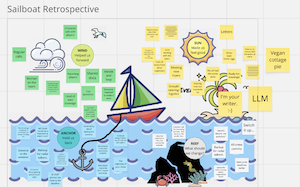
In work – I try and be thoughtful after every project. So do Allied Games. We solicit feedback, and we run retros. We record, and we learn, and we try and do so in the open.
We’ve taken the negative elements from our reviews, and stashed them alongside the results of a feedback form we sent out. At some point, I’ll try write something about the whole.
For now – I want to talk about our writing process.
It started with Ian Thomas’ work on the first run. He’s written about it here. It’s a cracking piece, go read it… The second run, we were essentially the same: two blokes, communicating with players through comment threads on Google Docs. Starting with tags, getting to a character the player was happy with, with established connections forged on Facebook. Times 55.
We iterated a little for this run, though.
Firstly – we had five writers. Each had responsibility for a dozen or so players. We kept in touch with a weekly checkin. That was optional – I don’t think anyone went to all of them – but they did their job. Kept us (mostly) honest towards our deadlines, shared the creative load, and shared techniques we’d found worked. Importantly, also made us a team, as well as five individuals. Essentially – we had a weekly standup.
Secondly – and I think most significantly, we had women writers working with the players of female characters. I can’t overestimate the influence I think that had. I am absolutely sure it helped make our WAAF characters more nuanced, and true to their gender. While it’s true that we wrote as a team, and input from every writer was used everywhere, that was glorious. (I think maybe one WAAF character started with a conversation with a make writer?)
Thirdly – we used phone calls more. This was from Nora. I asked her to share her call framework, and it’s further down. While some asynchronous chats worked, a call is really useful basis, and more efficient in writer time too.

Fourthly – we used AI. Not to generate the characters – that was a collaboration between the players and the writer, as I’ve said. No, the AI was to suggest relations the player might want to explore. It went like this: I uploaded the characters into NotebookLLM, and then asked it questions…
The most common one was asking for three people who might have a dramatic relationship with a particular players’s character. I’d let the player know, and they and the other player would agree to flesh that out and take it not the game or not.
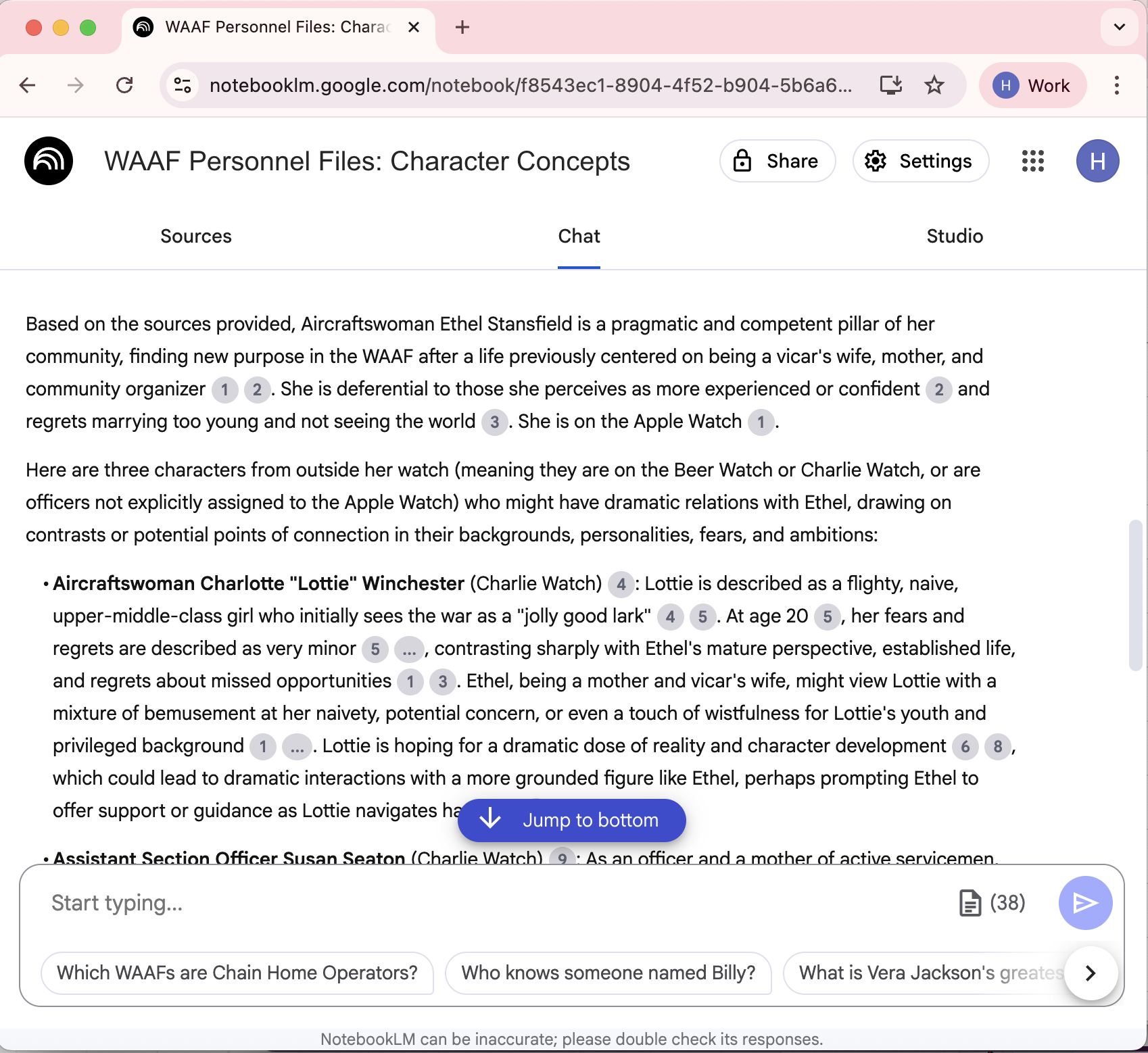
Importantly, these answers couldn’t be “wrong”. If the AI hallucinated a relation that made no sense, either I’d catch it before suggesting it, or the players just wouldn’t take it up. What we often did get, though, was some really astute ideas – really quickly, and without me having to know everything about every character.
Ours is a game without secrets, so the LLM was doing nothing a player couldn’t do themselves – it was simply let me be more proactive in helping out. I’d exercise a little editorial control too. When one character was being suggested as a possible romance with almost literally everyone on the base, I just stopped including her every time the LLM mentioned her.
The basis was the same as previous runs, though. Tags, key questions, and a core concept that we developed alongside the player. The thought being writing *with* rather than *for* them gets a character they are totally invested in. Our feedback suggests that the more we wrote as a partnership with a player, the happier they were. (And to the player who said they felt ‘shortchanged’ by being told they were ‘free to write their own’ – yup, my bad. I won’t do that again. While it’s *true*, I don’t think it’s *best*.)
If I were using this evolution of the method again, I’d make it clearer, I’d make it consistent, and I’d make it a contract. A bit like this…
Our writing promise
We’ll ask you to choose three ‘tags’ from our list. The ones that speak loudsest to you about the character you want to play.
We’ll ask you to think of a core concept, and their fear, ambition, and regret. If you’d prefer our suggestions ask us for them, but please don’t ask us to ‘fit you in where it’s useful.’ We want your character to be yours.
We’ll paste your concept, tags and fear, ambition, and regret into a document.
You’ll be allocated a writer. They’ll pose a handful of key questions in the doc, to start you thinking.
They’ll have an hour long call with you, knocking ideas back and forth as you both explore the character more.
They’ll expand their notes into a draft character. Specifically, they’ll suggest a handful of bullet points you could use to ask the player group for pre-game connections with their characters in a process commonly called “Looking for Relations” or LFR. This is optional; but our experience is that it really helps give you the best experience at the event.
From then, that character is yours.
All we ask is you keep it up to date as you develop them further. This is for two reasons.
Firstly – we’ll feed them into Notebook LLM, and ask the AI to suggest characters yours might have dramatic scenes with. We’ll use that to help you look for relations if you look to need it. We can’t use information we don’t know.
Secondly – we’ll be writing plotlines for the event. We’ll try and make sure all the tags players have chosen have additional play available. That might involve us asking you additional questions – we won’t impose answers on you. We can’t be consistent with your background if you’ve not written it down.
That framework for a conversation…
This is verbatim Nora: “My questions tend to be very factual – the emotional stuff comes with their answers and our discussion of them.”
- Welcome
- Thank them for their time – say how excited we are to have them on board!
- Introduce self: “I’m your writer and we have this hour-long slot today to get your character to the point where you can put out a ‘dating profile’ on the group.” We’ll aim to finish this session with a character hammered out – I’ll take notes and then send you a write up afterwards, but stress that none of this is set in stone, if you look at it in a few days or during the build up to the game, or even in-game! and want to change something, just tweak the google doc or hit me up for another chat. I’ll be available to you up until Time In and I love nothing more than talking about characters 🙂
- Quick question – remind me, are you a returning player? If not: Yay, you’re in for an amazing experience. If yes: Awesome (you may remember me etc) – are you looking to do something very different to last time.
- So, let’s have a look at your application form/did you have something in mind? If they do, go from there (and these notes are less relevant), if not, brilliant, let’s build them!
(Note: keep quick recapping after each section or so to make sure the character is working or needs adjusting and they don’t feel they’re being pushed)
- First things first – do we have a name (push to pin one down, even if just a first name and refer to the character by name from this point onwards)
- OK so, young or old?
- Upper class, super posh, working class, somewhere in the middle? Further define – rough criminal working class or respectable terrace? Surrey upper class or landed gentry or bohemian arty? Happy middle class or restrictive and stifled?
- Happy childhood? Deep trauma? Did her childhood shape her in big ways or was it very normal? What did her parents do? Siblings?
- From any particular part of the country?
- Obviously they were bright or they’d not have been selected for this role, but what sort of education? Did they love school and win a prize, or were they never much good at book-learning? Would they have liked to study more? Train professionally? Did they go to finishing school?
- So, X, left school in whatever year and the game is 1940, so what was she doing for those x years. Talk about career/travelling/relationships/living arrangements…
- And how did the outbreak of war affect her/her family/her job/her city? Where was she the day war broke out?
- What made her sign up? Talk about that day. How did her family/friends feel about it?
- What was it like to be in training – suddenly sleeping in a dormitory with an ill-fitting uniform having to do as she was told – how did she respond?
- And once training was over – how does she feel now about the actual job? Enjoys the challenge, competent, struggling, bored, stressed? Has she had any hard moments yet?
- And when she’s not at work, where would you find her on base off-shift, what’s she like socially? Life and soul of concert parties or quietly reading? Naughty joker? Keen church-goer? Instigator or joiner-in?
- Romantic relationships if not already discussed? Team dynamics? Friendships?
- How does she feel about pilots – especially being on base with them for maybe the first time?
- Recap everything, summarise her, make sure she has some really unique aspects that bring her alive. Go back to original fears/ambitions/regrets and see if they still work or if they should change.
- Suggest/discuss people she might want to make friends with.
- Thank profusely for their time, say how great the character is, super looking forward to seeing them.
- Chuck notes in ChatGPT and generate character sheet including 50 word summary/LFR bullet points suitable for Facebook, share back to player.
Huge thanks to the writers – Nora Black, Sarah Fitzgerald, Russel Smith and Virginia Wynn-Jones – and to every player and crew member for making such a memorable run.
I’ll leave the last word to one of our players.
“I thought it was outstanding. The IC job aspects were incredibly compelling, the setting and immersion was superb and there was clearly a vision for the game that was clearly conveyed and that everyone bought into. Best larp I’ve been to.”
 LARP experience
Leave a Reply